How to Remove Hair Extensions Safely
At some point every extension wearer needs to remove hair extensions, whether maintenance is due, you are changing your look, or you simply fancy a break. Done correctly, removing extensions is straightforward and leaves your natural hair healthy underneath; done in a rush or with the wrong method, it can cause real damage. In this guide, a specialist at Hair Nova Salon in Finchley explains how to remove hair extensions safely for each type, when you can do it at home, and when it is genuinely better to leave it to a professional.
Can You Remove Hair Extensions at Home?
It depends entirely on the method. Clip-in extensions are designed to be removed at home daily and are the easiest of all. Tape-in extensions can be removed at home with a proper adhesive remover and a little patience. However, nano rings, micro rings, fusion bonds and sew-in wefts are far more fiddly, use specialist tools, and are much easier to get wrong, so these are best removed by a professional. The golden rule is simple: the more permanent the method, the more it pays to have it removed properly.
Why Professional Removal Is Always Safest
There is a reason stylists recommend professional removal for semi-permanent extensions. A trained specialist has the correct tools and solutions, works methodically to protect every strand of your natural hair, and can spot and prevent the tension or breakage that home removal often causes. Just as importantly, careful professional removal keeps your extensions in good enough condition to be reused, which saves you money at your next fitting. It is also a chance to check the health of your scalp and natural hair before deciding what to do next.
How to Remove Tape-In Hair Extensions
If you are removing tape-ins at home, take your time. First, brush your hair thoroughly to remove any tangles. Section the hair so you can see the first row of tapes clearly, then saturate the bonds generously with a dedicated tape or adhesive remover and leave it for the time stated on the bottle. Once the adhesive softens, gently peel the tape apart from the edge and slide it out, never yanking. Afterwards, wash with a clarifying shampoo to remove sticky residue and follow with a deep conditioner. Remember that tapes need professional reapplication.
How to Remove Nano and Micro Ring Extensions
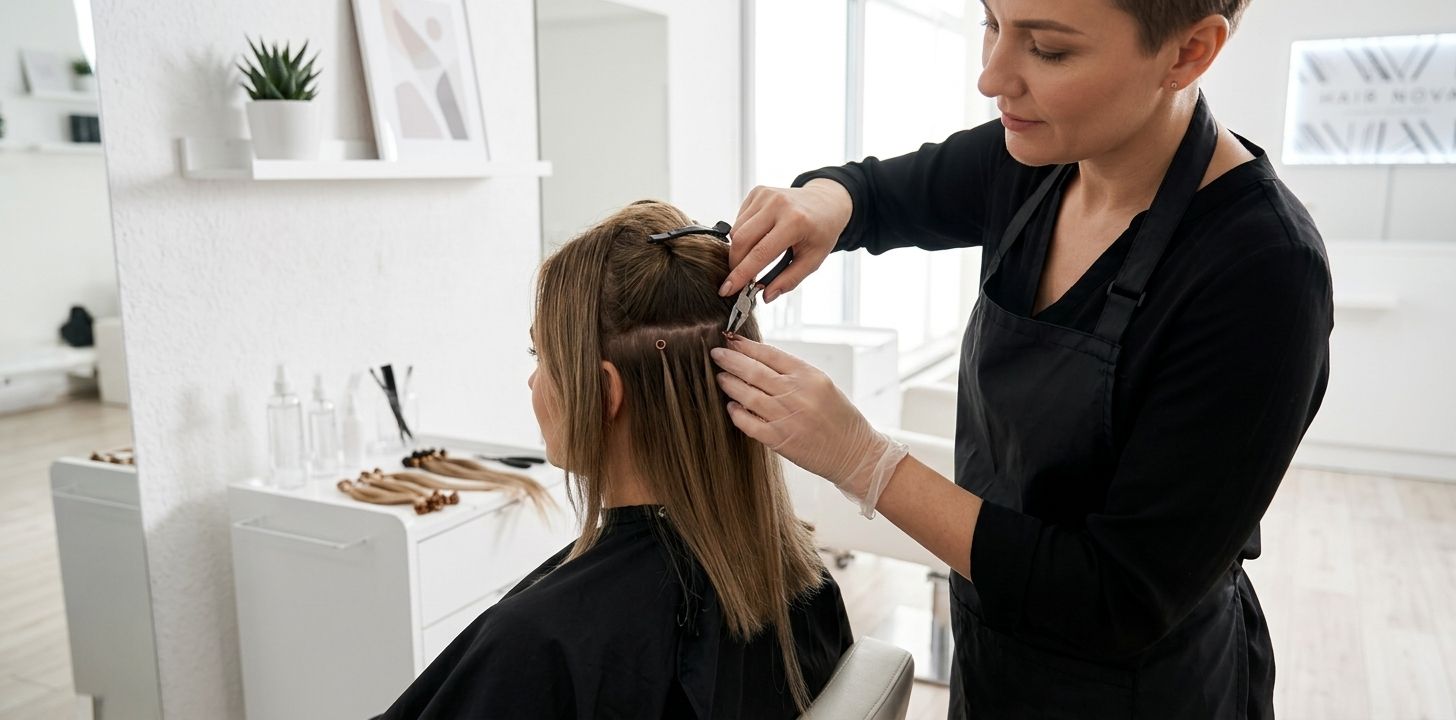
Ring methods are the trickiest to remove yourself, because you are working with tiny metal beads and specialist pliers. In principle, you section the hair, hold your natural hair firmly at the root just above the bead, and use the correct pliers to squeeze the ring open in the opposite direction to how it was closed, then slide the bead and extension off. In practice, it is fiddly, hard to see, and very easy to pull or snap your own hair, which is exactly why we strongly recommend having ring extensions removed by a professional.
How to Remove Clip-In Hair Extensions
Clip-ins are wonderfully simple, which is part of their appeal. Section your natural hair and clip it up out of the way, then locate each weft and gently press the clips open one at a time, holding the hair against your scalp to avoid any pulling. Slide each piece out and work methodically from the bottom up. Once removed, give the extensions a gentle brush and store them flat or hung up to keep their shape, ready for next time.
What to Do After You Remove Hair Extensions
Your natural hair needs a little love once the extensions are out. Start with a clarifying shampoo to lift away any residue, then apply a deep-conditioning or bond-repair mask, as your hair will not have had its usual oils distributed evenly while wearing extensions. Detangle gently with a wide-tooth comb, and give your hair a few days to rest before any heat styling or a new set. A trim can also freshen up the ends if they need it.
Common Removal Mistakes to Avoid
Most removal damage comes from a handful of avoidable mistakes:
- Pulling, yanking or forcing extensions out instead of loosening them first.
- Skipping the proper remover on tape-ins, or using harsh substances like acetone.
- Rushing the job rather than working slowly, row by row.
- Trying to remove ring or bonded extensions without the correct pliers.
- Removing extensions from soaking wet hair, when strands are at their most fragile.
Do Not Panic About Shedding
When you remove hair extensions, especially after several weeks, you may see what looks like an alarming amount of hair come away with them. Try not to worry, as this is almost always completely normal. We naturally shed fifty to a hundred hairs a day, and while you are wearing extensions those shed hairs are held in place by the bonds instead of falling out. When the extensions come out, all that normal shedding is released at once, so it looks like a lot, but it is not extra hair loss.
How Often Should You Remove Hair Extensions?
This depends on the method rather than a fixed rule. Tape-in extensions are typically removed and repositioned every six to eight weeks as your natural hair grows, while nano and micro rings can usually go three to four months between maintenance. Leaving semi-permanent extensions in for far longer than recommended is one of the most common causes of matting and damage, because your natural regrowth shifts the bonds away from the scalp and they start to tangle. Sticking to your maintenance schedule is the single best way to protect both your hair and your extensions.
How to Remove Fusion and Bonded Hair Extensions
Fusion or keratin-bonded extensions are attached with a hardened glue bond, and they are genuinely not a home job. Removing them requires a special bond-breaking solution and a careful technique to crumble the softened bond without snapping the hair, followed by thorough cleansing to lift out any residue. Attempting this yourself risks both breaking your natural hair and leaving glue stuck in it. For fusion and bonded methods, always book a professional removal, as the small cost is far cheaper than repairing damaged hair afterwards.
Should You Remove Extensions Before a Holiday?
It is a common question before a beach holiday, and the answer depends on your method and plans. Quality semi-permanent extensions are generally fine for swimming and sun as long as you protect them, rinse after chlorine or salt water, and keep up gentle care, so most people keep them in. If your maintenance happens to fall around your trip, though, it can be worth timing removal or a refit just before you go, so you travel with a fresh, secure set rather than one that is due to come out.
Book Professional Removal in Finchley
If you have semi-permanent extensions, the safest option is to let us remove them for you, and refit or refresh at the same time if you wish. Whether you wear our tape-in extensions or our nano ring extensions, our specialists will remove them gently and check your natural hair while they are at it.
Ready to book? Book online on Fresha or call 020 8129 4894. We are at 375 Regents Park Road, Finchley, one minute from Finchley Central Station.
FAQ
Clip-ins easily, and tape-ins with a proper adhesive remover, yes. Nano rings, micro rings, bonds and sew-ins are best removed by a professional to avoid damaging your natural hair.
Not when it is done correctly and gently. Damage comes from pulling, rushing, removing wet hair, or working without the proper remover or tools.
Brush and section the hair, saturate the tapes with a tape or adhesive remover, wait for it to soften, then gently peel from the edge and wash out any residue with a clarifying shampoo.
It can look alarming, but the clump is mostly normal daily shedding that was held in by the bonds while you wore the extensions, not extra hair loss.